
In today’s search landscape, focusing only on keywords isn’t enough. Search engines like Google and LLMs are smarter, and they are trying to understand meaning, intent, and context, not just match exact words on a page. That’s where Semantic SEO comes in: an advanced approach to optimization that helps your content rank better, attract the right visitors, and ultimately convert them into customers.
Understanding and implementing semantic SEO is essential. In this guide, we will break it down clearly and help you build a strategy that works.
What Is Semantic SEO?
At its core, Semantic SEO is about helping search engines understand the meaning behind content, not just the individual keywords. Instead of ranking pages only for exact words, semantic SEO focuses on:
- User intent — what the searcher actually wants
- Context — the topic in its entirety, including related subtopics
- Concepts & entities — how ideas are connected
This is fundamentally different from old-school SEO where the goal was to insert target keywords as much as possible. Semantic SEO helps search engines understand the purpose and message of your content, leading to better rankings and more relevant traffic.
Semantic SEO vs Traditional SEO: Key Differences
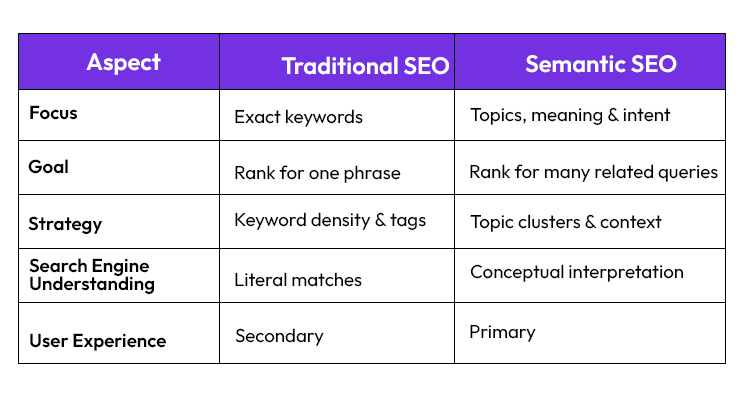
Semantic SEO is about building topical authority, showing search engines that your content covers an entire subject comprehensively. Traditional SEO often targets specific search terms without the depth or context that modern algorithms reward.
Why Semantic SEO Matters More than Ever for Businesses and Brands
Semantic SEO isn’t a trend it’s the future of search. Here’s why it’s more important than ever:
Better Match with Search Engines’ Evolution
Search engines now use advanced models (like semantic search and generative AI) to interpret queries, analyze meaning, and deliver contextually relevant results. They try to understand what the user actually wants, rather than just what they type.
Improved Rankings & Visibility
When you optimize around entire topics rather than single keywords, your content is more likely to appear for a broader range of relevant search terms.
Enhanced User Engagement
Content that answers user intent keeps people on your site longer, which in turn signals value to search engines using the SEO semantic code analyzer WordPress.
Higher Conversions & Leads
Semantic SEO directs qualified traffic, meaning users are more likely to take action, whether that’s signing up, requesting a quote, or purchasing a product.
Core Concepts in Semantic SEO: Key Components to Understand
Let’s break down the fundamentals of semantic SEO and its key factors:
Semantic Search
Search engines interpret queries based on meaning not just keyword matches. They look at context, concept connections, and the intent behind queries.
Entities & Context
An entity can be a person, place, thing, idea, or concept. Google’s Knowledge Graph uses these to link related ideas, helping search engines connect the dots between related terms.
User Intent
Intent can be classified into:
- Informational — seeking knowledge (“what is semantic SEO?”)
- Navigational — searching for a specific site
- Transactional — ready to buy or submit info
Understanding semantic tags for SEO intent determines how you shape content.
Related (Semantic) Keywords
These are conceptually connected phrases that help search engines understand your topic better. Tools and search suggestions can uncover these related terms to enrich content.
Structured Data & Schema
By using schema markup (like JSON-LD), you help search engines interpret your content semantically which can lead to enhanced search features like rich snippets and FAQ blocks.
Also you can read our complete guide on SEO blog writing so can implement semantically structure organized for Google and other search engines.
How Semantic SEO Works: Step-by-Step Process to Follow
Now, let’s look at how semantic SEO actually functions within a strategy.
Step 1: Understand Intent
Before writing, determine what users are truly looking for when they search your topic. Are they seeking info? A solution? A purchase option? That is what SEO semantic writing is all about.
Step 2: Topic-Centric Keyword Research
Rather than focusing on one keyword, identify thematic groups of related phrases that show how users express intent. These include:
- Semantic keywords
- Related questions
- Latent contextual terms
Incorporating these gives search engines a fuller picture of your content’s meaning.
Step 3: Organize Content for Meaning
Use clear headings (H1, H2, H3) and structure your content in topic clusters with a main page supported by related subtopics.
Step 4: Optimize Technical Elements
Implement schema markup, clean URL structures, and optimized metadata to reinforce semantic meaning.
Step 5: Continually Measure & Improve
Track engagement metrics like time on page, bounce rate, and conversion events to refine both content and strategy.
Semantic SEO Tools You Should Use at Present to Get Fast Results
To implement semantic SEO effectively, here are some powerful tools:
| Category | Tool | Purpose |
| Keyword & Topic Research | Semrush / SurferSEO | Find semantic keywords & topic suggestions |
| Semantic Analysis | Google NLP API | Understand entity context and phrase meaning |
| Structured Data | JSON-LD Generators | Build schema for FAQ, articles & products |
| Content Planning | Answer The Public | Discover related questions users ask |
| SEO Reporting | Google Search Console | Track the semantic tag HTML SEO performance on related queries |
Using these tools will help you dig deeper into topic intent and build richer content that outperforms competitors.
Semantic SEO Best Practices to Implement and Derive More Leads
Here are actionable tips to get the most from your semantic strategy:
- Create Topic Clusters: Connect related content with internal links to show comprehensive coverage of your subject area.
- Write for Humans First: Semantic SEO solutions are about meaning, so make your content useful and engaging.
- Use Structured Markup: Add schema for articles, FAQs, products, and more to help search engines understand your content’s context.
- Incorporate Related Concepts Naturally: Include semantically related terms and variants to show topical relevance without stuffing keywords.
- Monitor & Update Content: Search semantic structure SEO trends evolve, refresh your content to match new search behaviors.
Difference Between Semantics & LSI: What You Should Know
A commonly discussed part of semantic SEO is Latent Semantic Indexing SEO. The term refers to the concept of relationships between words. However:
Google does not officially use latent semantic indexing LSI in SEO as a ranking factor, yet using related terms is still valuable because it shows depth and relevance.
In semantic SEO practices, including incorporating synonyms, related phrases, and contextually relevant words, strengthens your topic authority and helps search engines interpret the full meaning of content.
Content Structure That Aligns with Semantic SEO: Example Template
A semantic markup for SEO content structure uses logical headings and subtopics. Here’s a recommended outline:
- Introduction: Topic explanation and importance
- What is Semantic SEO
- Semantic vs Traditional SEO
- Why It Matters Today
- How Semantic SEO Works
- Tools & Tech You Need
- Best Practices
- Common Mistakes to Avoid
- Case Study/Example
- Final Thoughts & CTA
This semantic SEO knowledge graph structure ensures your content answers related user intents and positions your page as a topically authoritative resource. Also, you can read our guide on the on-page SEO checklist here for further understanding of the concept.
Common Semantic SEO Mistakes That Can Hurt Your Rankings
The best semantic SEO strategy may fail miserably unless some slip-ups creep in your execution. The following are the most common pitfalls that are discussed in order to prevent them:
• Keyword stuffing — hurts readability and SEO.
Keyword stuffing: It is putting the same word into your text many times in an unnatural manner. Not only does this go against the rules of search engine quality (Google regards this as spam) it is also very hard and unpleasant to be read by actual users. The value of the naturally written content is more favored by the modern search engines in comparison to the manipulation-based methods.
• Over-focusing on one keyword — misses broader context.
When you focus on one keyword only, you will be restricting your exposure since you are not taking into account any other related concepts and search intents that are of interest to the users. Semantic HTML SEO flourishes on topical coverage by the inclusion of related phrases and entities to demonstrate mastery over a topic. Otherwise, you can get a ranking of competitors in the search engines that would be more comprehensive.
• Ignoring schema markup — loses rich result opportunities.
Structured data such as schema (e.g., JSON-LD) assists search engines in interpreting the content context to indicate the associations between entities and information types. You may not have better search capabilities, such as rich snippets, FAQ blocks, and other search page boosts, without it to increase your visibility and clicks.
• Writing without intent — fails to satisfy user needs.
When you write more to please search engines and not actual solutions to the problems of the real users, your content will not fit what the users are searching for. Today, search engines are concerned more with content that is relevant to the user intent, be it informational, transactional, or comparative, as it will rank higher than generic, shallow copy.
Semantic SEO involves more consideration and planning, but the reward is more meaningful visibility and conversion. Contact us for leading SEO services in Pakistan.
Conclusion: Master the Art of Semantic SEO
The semantic analysis SEO is much more than a strategic trick in the fast-developing world of search. Semantic SEO is the actual need of every company that intends to succeed on the web. Contemporary search engines no longer simply search on the keywords, but will interpret the meaning, context, and intent of the user to make sure that the results of the search are indeed fulfilling the actual questions one intends to ask. This change implies that the content, which is constructed based on the subject matter, purpose, and semantic connections, has a significantly greater chance of being comprehended by the algorithms and gaining an opportunity to see through, engage, and convert.
Semantic SEO is more than an advanced technique; it’s a necessity in modern search marketing. By focusing on meaning, user intent, and related context, you can:
- Improve rankings for a wider range of queries
- Attract more qualified visitors
- Increase engagement and conversions
- Build long-term SEO success
Want expert help implementing a semantic SEO strategy that drives real leads? Contact Fulfillit today and let us take your organic visibility to the next level.
FAQs
1. What is SEO semantic coding?
SEO semantic coding is the practice of using meaningful HTML and structured data to help search engines better understand page content, context, and relationships, improving visibility and relevance.
2. What is latent semantic indexing in SEO?
Latent semantic indexing (LSI) in SEO refers to using related keywords and concepts that help search engines understand topic depth and content relevance beyond exact-match terms.
3. How much does semantic markup help SEO?
Semantic markup helps SEO by improving content interpretation, enabling rich results, enhancing crawl efficiency, and increasing the likelihood of higher rankings and better click-through rates.
4. How do HTML5 semantic tags SEO help Google and LLMs?
Semantic html google SEO is like <article>, <section>, and <header>, which help Google understand page structure, content hierarchy, and intent, leading to improved indexing and user experience.
5. How does JSON-LD for semantic SEO improve and generate more leads?
JSON-LD for semantic connectivity in SEO adds structured data that helps search engines connect entities, earn rich snippets, and improve visibility often resulting in more leads from semantic SEO through higher trust and engagement.