
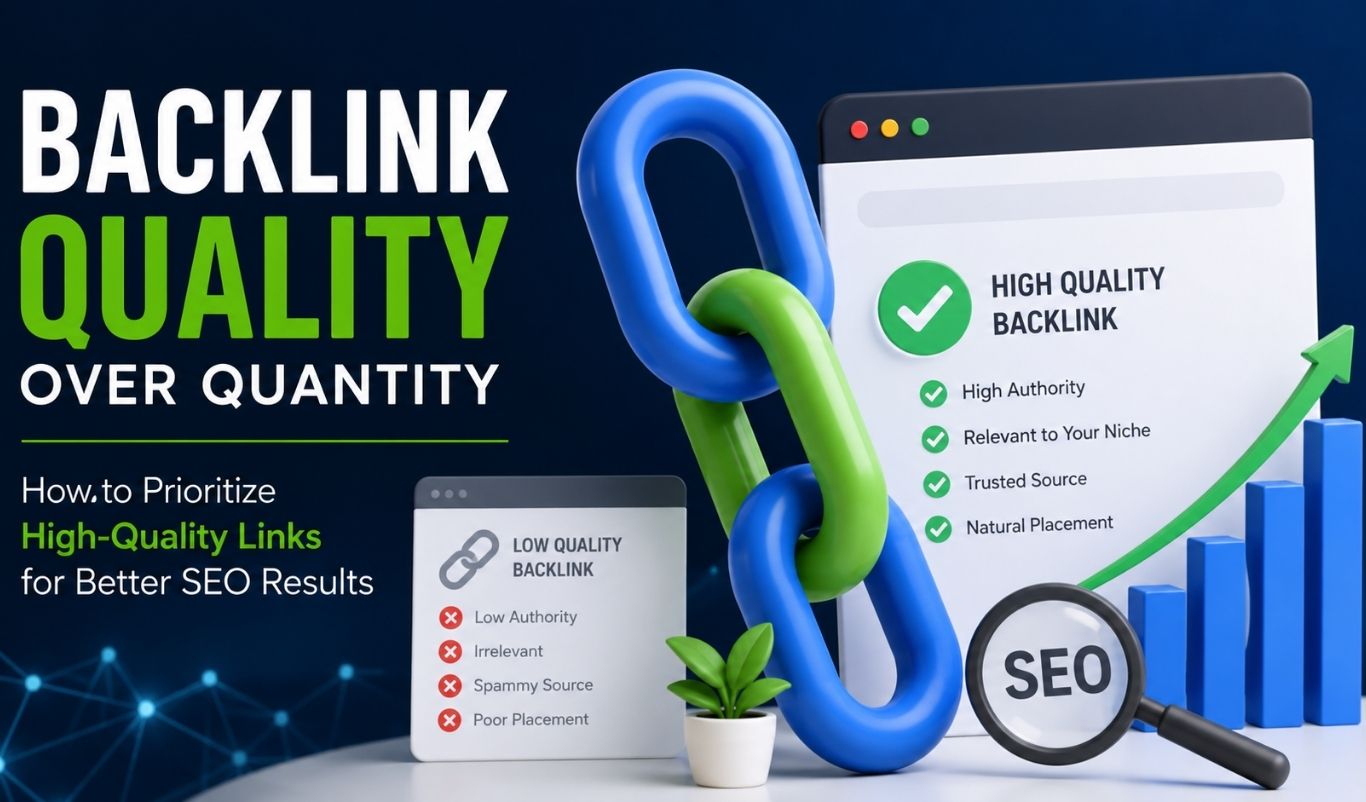
For every business owner who creates an online presence, the question that arises at some point is how many backlinks are required to rank higher in Google? It’s a legitimate question, but it’s not the one that should be asked. It is not as important how many links are pointing to your site, but rather where they are from and whether they are links that are valuable or not.
The quality of backlinks is what people refer to when they speak about this. One link from a reputable and established site in your niche can have a more significant impact on your search engine optimization than 100 links from random and poor-quality directories. It’s one of the top SEO errors that businesses make, and it can cost you big time.
This guide explains the meaning of the term “quality backlink” and how to determine which links are worth building, the difference between a quality and non-quality backlink profile, and how to create a strategy that will help you get long-term rankings and not just a quick boost.
What Is Backlink Quality and Why Does It Matter?
Backlink is a link between two websites. If website A links to website B, then it is effectively saying, “I trust website B. These links are essentially a sign of trust and relevance for Google. The more reliable the site that’s linking, the more powerful that signal will be.
The quality of backlinks is the amount of trust and authority that they actually deliver to your site. Not all links are created equal. If it’s a link from a government site or a respected industry publication, it has a tremendous amount of authority. A link from a new blog that doesn’t have much traffic has virtually no value.
Google’s algorithms are now very adept at telling the difference between the two. In fact, poor quality links don’t help. They can actually negatively impact your rankings if Google thinks they are a form of manipulation. That’s why it’s much more important to have quality backlinks than a lot of them.
What Makes a Backlink High Quality?
The first step to any good link-building strategy is to differentiate between good and bad links. A link’s true value depends on several factors.
Domain Authority and Trust
Domain authority is a measure of the amount of trust and credibility that a website has developed over time. High DA sites are also well-established with great backlink profiles and traffic. If any of these sites link to you, they give you some of that power.
The concept of trust is closely related. Google values websites that are a trusted source of information over newer, less established websites. High-trust domains include news outlets, academic institutions, government portals, and trusted industry publications.
Relevance to Your Niche
A link from a site that is related to your topic or industry is more useful than a link from a different site. If you have a skin care e-commerce business and you receive a link from a beauty blog, it’s a very relevant backlink. When you receive a link from a website on car parts, the relevancy signal is low.
Google would like to observe that the links that point to you have a topic connection. By letting the algorithm know the link is there for a legitimate reason, not just to create links.
The Position of the Link on the Page
The position of a link on a page will determine its value. A link that is integrated within the body of text and not in a footer or sidebar is much more beneficial than a link in a footer or sidebar. Editorial links are links that a writer has picked because they actually believe that your content is useful to them.
Anchor Text
The text that is used to link to another page is called anchor text. Using natural and descriptive anchor text that conveys the meaning of the page the link is pointing to will help Google to understand the context of the link. But if you use the same anchor text or keywords in numerous links, it appears manipulative. Quality backlink sites will have a variety of anchor texts that blend into the content.
The Do-Follow Vs No-Follow Distinction
Do follow links that transfer authority from the linking site to the site that you link to. No-follow links are links that contain a tag that prevents search engines from passing authority. While no-follow links continue to have a place on the internet, they don’t carry the same weight as do-follow links when it comes to rankings. High-quality backlinks are sought after with do-follow links from authoritative and relevant sites.
Why Chasing Link Numbers Without Focusing on Quality Is a Problem
Several years ago, it was possible to simply generate links, no matter where they came from, and rank websites. That era is over. Google has updated its algorithms, especially Penguin, first released in 2012 and integrated into the main algorithm in 2016, significantly altering the way backlinks are interpreted.
A link profile with poor-quality links is a red flag today. It lets Google know that a site might be attempting to game the system. This can culminate in a hand rejection or algorithmic downgrade, which can lead to a massive drop in rankings. Link recovery can be a lengthy and arduous process, and involves the disavow process, which is essentially a formal request to Google not to consider some links to your site.
The bottom line is this: 50 solid, quality, relevant links from reputable sites will always be better than 500 links from generic link farms. The process of creating a quality backlink profile is a slower process, but the results are more stable and have less risk.
How to Identify High Quality Backlink Sites Worth Targeting
When assessing a potential source of links, you’ll save time from chasing links that won’t affect the needle. Before contacting any site for a link, check the following:
- Domain Rating or Domain Authority score: These tools, such as Ahrefs, Moz, and SEMrush, give a score to websites based on their backlink profile. As a rule of thumb, try to target sites with a page rank of between 40 and 50, but if the site has a lower page rank, but is in a very relevant niche, it may be worth the effort.
- Organic traffic: If the website has a strong organic traffic, then Google will trust this website enough to send traffic to it. Even if you have no traffic to your site, you could be penalized or never develop any authority. Linking from these types of sites will be of little benefit.
- Content quality: Go to the site. Does the material have good writing, is it useful, and is it updated regularly? Is it more of a genuine resource or more of a site built just for links? Creating quality content is a good gauge of a reputable website.
- Existing link profile: Find out who is linking back to your website. If the site has a good inbound link profile, it is recognized in its niche. If there are lots of other low-quality websites that link to it, it will be a red flag.
- Spam score: Moz gives websites a spam score. A high spam score indicates that the site has some of the traits of a penalized or low-quality domain. Don’t accept links from websites with a high spam rating.
Effective Ways to Get Quality Backlinks
The mindset needed to build high-quality backlinks is different from just going out there and grabbing links. Earning the best links is through hard work, relationship building, and valuable content. Here are the ways that work.
Guest Posting on Relevant Websites
One of the oldest and most effective methods to get good-quality backlinks is to create articles for well-known websites in your niche. What matters is that the websites are actually well respected in your niche, not just websites that are created to publish guest posts for link building. With a properly executed guest post, you’re putting your expertise in front of a new audience, and you’re getting a relevant, editorial link back to your site in return.
Digital PR and Brand Mentions
One of the best types of link building is when your brand is featured in news articles, industry round-ups, and expert commentary pieces. They’re from trusted publications that have lots of authority. Digital PR is about creating truly newsworthy content or stories that journalists and bloggers will want to write about. It can be based on a product launch, original research, a unique data point, or a strong opinion piece.
Broken Link Building
The idea behind this is to locate pages at quality websites that lead to resources that are no longer available and propose your own relevant content as a substitute. Both the website owner and you are well served here, as you are given a quality placement, and the owner of the site has the opportunity to repair a broken link. Tools like Ahrefs can help you find broken links on websites within your industry.
Creating Link-Worthy Resources
Links are earned over time and naturally because the content is useful. Other blogs and sites are interested in linking to your content, especially if it is original research, industry statistics, a comprehensive how-to guide, free tools, or well-designed infographics. This type of content marketing is a great investment for links, and it doesn’t require any outreach.
Building Local Citations and Niche Directory Links
Local citations, which are citations of your business name, address, and phone number in local directories, are part of your link profile for businesses that market to specific geographic areas. Well-maintained and curated directories that are also industry-specific are good to submit to. These are not as strong as editorial links, but they are legitimate indicators that search engines can use to learn about your business.
What a Quality Backlink Service Should Actually Do
In fact, there are many businesses that prefer to hire an external team for backlink building, particularly in the e-commerce and Content marketing sectors. This is an excellent practice if it’s provided by a trusted SEO company, and many will provide you with lots of inexpensive links that are actually detrimental.
A good quality backlink service should provide the following:
- Conduct a link audit first: Before building new links, a good agency looks at what you already have. Identifying and disavowing toxic links protects your domain before new efforts begin.
- Research relevant link targets: The service should identify specific, high-authority websites in your niche rather than using generic link directories.
- Create content that earns the link: The best services pair outreach with content creation. Getting a link often requires giving the linking site something worth referencing.
- Report transparently: You should always know where your links are coming from, what the domain metrics are, and what the anchor text is. Black-box link building with no reporting is a red flag.
- Focus on long-term results: A trustworthy service prioritizes sustainable link growth over shortcuts that can trigger penalties.
At Fulfillit, our off-page SEO service is built specifically around acquiring quality backlinks for SEO through outreach, content placement, and digital PR. We handle the full process from identifying the right websites to securing the link and reporting on results.
Backlinks as Part of a Wider SEO Strategy
While backlinks are hugely effective, they are best utilized when the rest of your SEO is in place. The link won’t add value if the page it points to is slow to load, has little content, or isn’t a good user experience.
On-page SEO ensures your content is relevant, well-organized, and search engine-friendly. On-page optimization is always included in our SEO services in Pakistan, as without good pages pointing to them, your links will not get the maximum benefit.
Technical SEO makes sure your site is crawlable and indexable. Search engines interact with your content in various ways, including your page speed, mobile usability, structured data, and site architecture. These are the fundamentals our technical SEO services cover so that your link-building efforts can be directed towards pages that are built to rank.
The three pillars of on-page and technical SEO have a compounding effect when they all work together. Every backlink you get on a technically sound site with a well-optimized page will have a more significant impact.
How to Track Whether Your Backlinks Are Working
As with any investment, it’s important to determine whether building high-quality backlinks is working for you. Here are the main points that you need to monitor.
- Domain authority or domain rating: The more quality links you gain, the higher your domain authority or domain rating should be. This is a lagging indicator, and changes will not happen overnight.
- Organic search traffic: When you are actively building links for pages and see traffic increase over time, this is a good sign that it is successful. Check this using Google Search Console and Google Analytics.
- Keyword rankings: Monitor page ranking for relevant keywords before, during, and after your link-building efforts. Better rankings for competitive keywords frequently directly correlate with link building.
- Referral traffic: Websites with real traffic can also provide you with high-quality backlinks. Track referral traffic in Google Analytics to understand what links are attracting users as well as passing authority.
- New links acquired vs links lost: Monitor backlinks over time. Both Ahrefs and SEMrush will display new and lost links. A steadily increasing link profile is a positive sign. If there are a lot of links that are lost, it could mean that the pages linking to you are of low quality or are unstable.
Conclusion
There is a definite answer to the question of quality vs quantity when it comes to backlinks. It’s a quality story, every time. A handful of links from a well-respected, relevant site will move your rank much higher than a thousand links from lesser, less relevant sites. Unlike bulk link schemes, good backlinks pose virtually no risk of being penalised as they represent real website trust.
It takes time and effort to build a good backlink profile. It requires finding the right sites to target, building content that others want to link to, developing relationships with the sites, and measuring results over time. There is no such thing as a shortcut that will last.
If you are a business in Pakistan or anywhere else in the world looking for high-quality backlinks that can be done systematically and transparently, then Fulfilit can be your answer. We do not offer bulk sales of links. We create the right kind of backlink profile that truly impacts your search rankings.
When you’re prepared to invest in a top-notch quality backlink service, reach out to our SEO team to discuss a strategy that is customized for your website and goals.
Frequently Asked Questions
1. What is backlink quality, and why does it matter for SEO?
Quality of backlinks is defined as the relevance, trustworthiness, and authority of the site that links to you. High-quality backlinks are those that are linked from a reputable web page that has a high domain authority and has genuine traffic. They are more valuable to search engines than links from spammy or irrelevant sites, and over time, are far more beneficial to your rankings and domain authority.
2. How many backlinks do I need to rank on Google?
There is no fixed amount. The important thing is that they are good quality backlinks compared to the competition for the keywords you’re going after. You can build 10 good links from authoritative sites that are relevant to your niche, and get hundreds of poor links. You can get 10 quality links from relevant authority sites and hundreds of poor links. Prioritize quality links over quantity links.
3. What is the difference between high-quality backlinks and low-quality ones?
The websites that provide high-quality backlinks are those with high domain authority, organic traffic, relevant content, and editorial standards. Poor-quality backlinks are created by link farms, private blog networks, low-quality directories, or websites that only sell links. The latter will help your ranking. The latter can result in penalties.
4. Can bad backlinks hurt my website’s rankings?
Yes. Google may manually downgrade your site, or an algorithmic downgrade, if you receive a lot of spammy or low-quality links. If you’ve inherited a toxic link profile, you can upload a disavow file to Google Search Console to request that Google ignore such links.
5. How do I find high-quality backlink sites to target?
Use tools such as Ahrefs, Moz, or SEMrush to find high domain authority websites in your niche that have real organic traffic. Seek out blogs that feature editorial posts, guest posts, or external resources. Domain authority scores are not the only thing that matters; relevance to your topic area is of equal importance.