
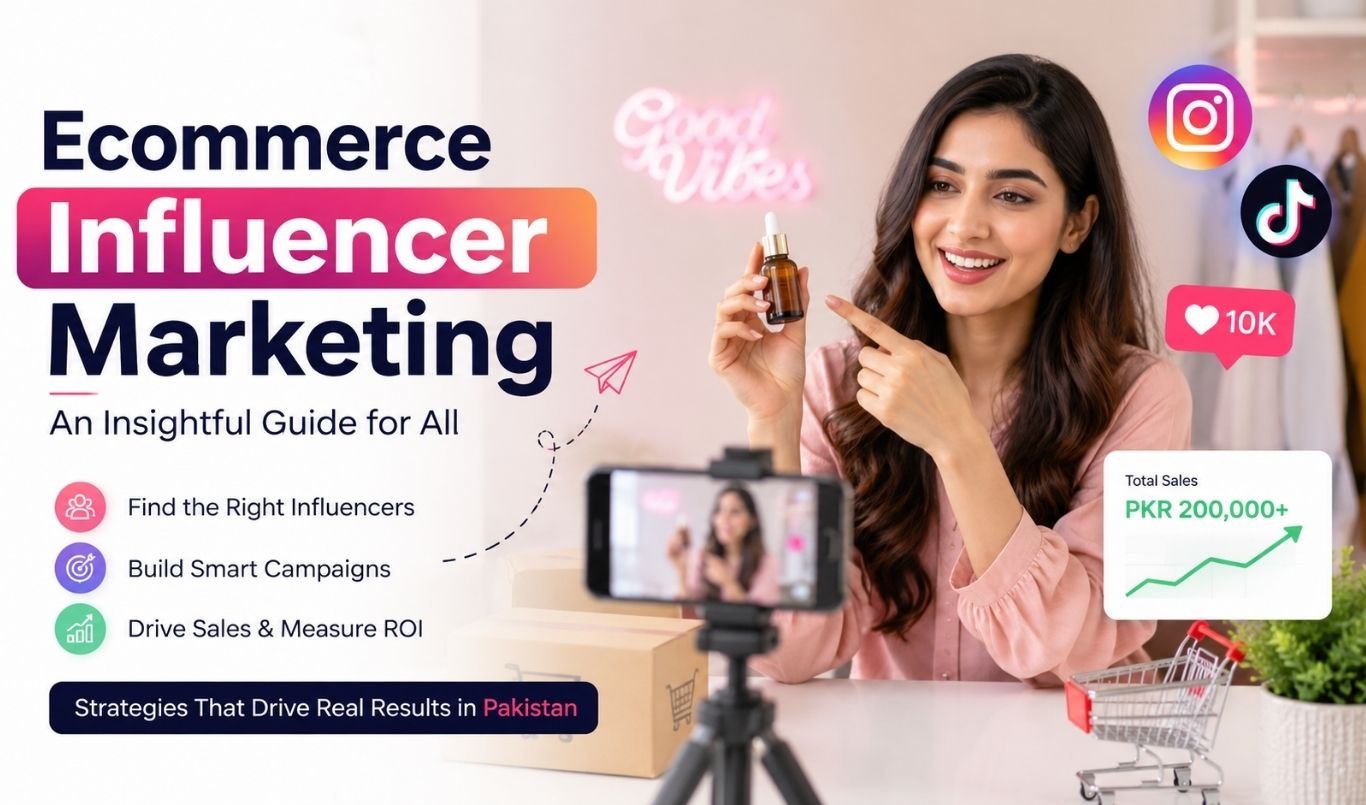
Ecommerce influencer marketing is how Pakistani brands are winning customers that paid ads can no longer reach. But why do some brands spend PKR 50,000 on influencer posts and see zero sales, while others turn that same budget into PKR 200,000 in revenue? The difference is never luck. It is always strategy.
Pakistan has over 44 million active social media users (DataReportal, Digital 2024 Pakistan), and Instagram and TikTok are where buying decisions are made for audiences aged 18 to 35. Display ads are getting ignored. Creator recommendations are not.
This guide covers how to find the right creators, build a strategy, measure ROI in PKR, and avoid the mistakes that waste budgets for Pakistani Shopify stores, D2C brands, and social sellers alike.
What Is Ecommerce Influencer Marketing
Ecommerce influencer marketing is a strategy where online brands partner with social media creators to promote their products to the creator’s audience, driving traffic, brand awareness, and direct sales through trusted recommendations rather than traditional advertising.
A Karachi-based skincare brand partners with a beauty creator who has 80,000 Instagram followers. The creator posts an honest review, shares a discount code, and links to the product page. Her followers click through and buy. That is ecommerce influencer marketing working as it should.
The difference from traditional advertising is intent. A billboard on Shahra-e-Faisal interrupts your audience. An influencer recommendation arrives inside content the viewer chose to watch. For Pakistani buyers aged 18 to 35, that context shift changes everything.
The Benefits of Ecommerce Influencer Marketing
Done right, influencer marketing delivers returns that most paid ad channels struggle to match. Here is why Pakistani ecommerce brands are moving budgets toward creators.
Reach new customers through trusted voices
In Pakistan, influencer content does not stay on Instagram. It gets screenshotted and forwarded through WhatsApp family groups, multiplying your reach well beyond the original post. You pay for the audience once. WhatsApp amplifies it for free. That is social proof working at scale.
Build brand trust faster than paid ads
Pakistani consumers scroll past Facebook and Instagram ads without stopping. A 2023 Edelman Trust Barometer report found that 63% of consumers globally trust influencer recommendations more than brand advertising. When a food blogger with 30,000 engaged followers recommends your product, it creates purchase intent that no retargeted ad can match.
Turn influencer content into a reusable brand asset
Most Pakistani brands treat influencer content as a one-time post. It is not. User-generated content (UGC) created by influencers can be repurposed in Facebook Ads, product pages, and WhatsApp campaigns with the right usage rights agreement. One well-produced video can serve your brand for six months across multiple channels.
Types of Influencers: Which Tier Is Right for Your Ecommerce Brand
Ecommerce influencers come in four tiers defined by follower count. But follower count alone tells you very little about results. What matters is engagement rate, audience quality, and whether their niche matches your product. Here is how the tiers break down for Pakistani brands.
| Influencer Tier | Followers | Avg. Engagement Rate | Typical PKR Cost / Post | Best Use Case |
| Nano | 1K – 10K | 5% – 8% | PKR 3,000 – 15,000 | Hyperlocal D2C, new brand launches |
| Micro | 10K – 100K | 3% – 6% | PKR 15,000 – 60,000 | Fashion, skincare, food startups |
| Macro | 100K – 500K | 1% – 3% | PKR 60,000 – 200,000 | Seasonal campaigns (Eid, Ramadan) |
| Mega | 500K+ | 0.5% – 1.5% | PKR 200,000+ | Mass brand awareness, celebrity tie-ins |
Note: PKR cost estimates reflect current Pakistani influencer market rates and vary by niche, platform, and content format.
Nano influencers (1K–10K): community-level trust, lowest entry cost
In Pakistan, nano influencers are hyperlocal. A Karachi foodie with 6,000 followers who replies to every comment converts better for a local D2C brand than a macro celebrity receiving 50 gifted products a week. If your budget is tight or you are entering a new niche, start here.
Micro influencers (10K–100K): the sweet spot for Pakistani D2C brands
Micro influencers give you the best balance of reach, engagement, and cost. Influencer marketing for ecommerce brands in fashion, skincare, tech, and home decor works best at this tier; audiences are niche, rates are negotiable, and most creators are open to affiliate structures. If you can only invest in one tier, this is it.
Macro and mega influencers: brand awareness at scale
These make sense for seasonal campaigns around Eid or Ramadan where the goal is brand awareness, not direct conversion. Engagement rates drop sharply as follower count rises. A PKR 200,000 Eid post delivers wide reach but rarely drives direct sales. Match the tier to the goal.
How to Choose the Right Influencer for Your Ecommerce Store
Choosing the wrong approach is how Pakistani brands waste their budgets. Three stages: find candidates, evaluate them, audit for fraud before you spend anything.
Manual discovery: niche hashtags, brand mentions, and your own buyers
Search #PakistaniFashion, #KarachiFood, #SkincareReview, #MadeinPakistan on Instagram and TikTok. Look for consistent posting and genuine comments, not just emoji reactions.
The most overlooked method: your own customers. A buyer who already loves your product and has 2,000 followers is your warmest influencer lead. Check your order history for anyone who has tagged your brand. This is also the best way to find Shopify influencer program partners; start with people already buying from you.
What to evaluate before you reach out: engagement rate, audience fit, content quality
A healthy engagement rate for micro influencers is 3% to 6%. Calculate it: average interactions divided by follower count, multiplied by 100. A creator with 50,000 followers and 500 interactions has 1% low. One with 15,000 followers and 600 interactions has 4%. Pay for the second one.
Demographics matter equally. A Pakistani skincare brand targeting women aged 20 to 35 gains nothing from an influencer whose audience is 80% male. Always request an Instagram Insights or TikTok analytics screenshot before committing.
Red flags: fake followers, bought engagement, and how to audit for free
Pakistani brands regularly overpay for inflated follower counts. Watch for:
- Sudden follower spikes with no clear reason
- Generic comments: “Great post!” “Love this!” with no specifics
- High followers but unusually low video or Story views
- Following 80K accounts while having 100K followers
Use HypeAuditor’s Instagram Audit Tool and Social Blade (free) to audit influencers before paying. These tools can help you assess audience quality, engagement, and suspicious follower patterns. An account that gained 20,000 followers in one week may require closer investigation.\
Developing an Effective Ecommerce Influencer Marketing Strategy
A strong influencer list means nothing without a strategy. Brands that skip this spend money on disconnected posts and cannot tell what worked.
Set campaign goals and KPIs before you reach out
Brand Awareness and direct sales need different tiers and formats. A Shopify store launching a product needs reach, track impressions, and follower growth. A brand running an Eid flash sale needs conversion, discount code usage tracking, and sales attribution. Decide the goal before you pick the influencer. For influencer marketing on your Shopify store, the analytics dashboard tracks traffic sources and conversion by UTM parameter from day one.
Influencer campaign types: gifting, paid posts, affiliate, and brand ambassador
Pakistani brands almost always start with product gifting free products in exchange for a post. The problem: gifting guarantees nothing. Many Pakistani brands have sent PKR 30,000 worth of product and received zero posts. Get the commitment in writing before you send anything.
The four structures: gifting (no guaranteed post unless contracted), paid posts (flat fee, guaranteed deliverable), affiliate (commission per sale via unique link or promo code), and brand ambassador (ongoing monthly relationship). For most Pakistani ecommerce startups, a paid micro influencer deal with an affiliate component delivers the best return.
What a strong influencer brief must include
A tight brief is the difference between content that converts and content that reads like an ad. Cover these seven elements:
- Brand overview: what you do and who you serve
- Campaign objective: what this post must achieve
- Content guidelines: what to highlight and what NOT to say
- Posting schedule: exact date and time
- Compensation terms: what the creator receives and when
- Approval process: review before publishing and by when
- Usage rights: can you repurpose this in paid ads
The biggest mistake: scripting content too tightly. Give the creator direction and let them deliver it in their own voice. That authenticity is what you are paying for.
Disclosure and transparency: why honesty protects your brand
Pakistan has no influencer disclosure law, but this is a brand trust issue. Pakistani audiences are media-literate. Undisclosed paid posts get exposed; and the backlash damages both the creator and your brand.
The fix: #ad or #sponsored in every paid caption. Audiences accept sponsored content. What they do not forgive is feeling deceived.
Building Organic Collaborations Through User-Generated Content
Paid partnerships build reach fast. The most durable social proof, however, is organic content real customers create themselves. User-generated content (UGC) costs almost nothing to encourage and builds trust no paid ad can replicate.
How to encourage customers to create and share content organically
Three tactics a Pakistani ecommerce brand can run this week:
- Send a post-purchase WhatsApp message asking customers to share an unboxing photo and tag your brand. Offer 10% off their next order as a thank-you.
- Create a branded hashtag and feature the best customer posts on your Stories and grid.
- Add a card to your packaging with your hashtag and a QR code to your Instagram profile.
The easier you make it to post, the more UGC you generate.
Repurposing influencer and UGC content in Facebook Ads and product pages
Influencer-created content is a production asset, not a one-time post. Authentic creator videos consistently outperform polished studio ads in Facebook and Instagram Ads. Pakistani brands that run them typically see a lower customer acquisition cost (CAC).
Confirm usage rights before boosting anything. An influencer retains copyright over their content by default. Get written confirmation, even a WhatsApp message, before you amplify it. Add usage rights as a standard clause in every brief.
Best Platforms for Ecommerce Influencer Marketing in Pakistan (2026)
Pakistan’s platform hierarchy is different from content what Western guides recommend. Here is what actually works.
TikTok: the fastest-growing influencer marketing ecommerce channel in Pakistan
Pakistan has over 40 million TikTok users; unboxing, GRWM content, and 60-second demos drive strong organic product discovery for audiences under 30, but TikTok Shop’s native checkout is not yet fully available in Pakistan, so use TikTok for discovery and traffic to your Shopify store only, keep your URL in your bio, and ask influencers to direct their audience there.
Instagram: product discovery, Reels, and Stories for Pakistani brands
Instagram is the primary influencer platform for Pakistani fashion, skincare, lifestyle, and home decor brands. Reels drive reach to new audiences, Stories convert warm followers through limited-time promo drops, and grid posts create permanent social proof, but Instagram Shopping is limited in Pakistan, so the practical goal is link clicks to your product page, not native checkout.
Facebook: amplification and reach for wider Pakistani audiences
No competitor covers Facebook for influencer marketing, which is a significant gap. Facebook dominates Pakistan’s 25 to 45 age group especially in tier-2 and tier-3 cities, so if your influencer creates a Reel and you hold usage rights, boost it on Facebook targeting women aged 25 to 40 in your relevant cities and you pay for the content once but reach two distinct audiences.
YouTube: long-form reviews that build purchase confidence
Mid-tier Pakistani YouTubers in skincare, tech, and food drive the highest purchase intent of any platform a 10-minute honest review builds far more purchase confidence than a 15-second Story for products priced above PKR 2,000, and a review posted today continues ranking in YouTube search for months, driving ongoing traffic with no additional spend.
Measuring and Tracking Influencer Campaign Metrics
The most common mistake Pakistani ecommerce brands make after a campaign is measuring the wrong things. A post with 10,000 likes but zero link clicks and zero promo code uses delivered nothing to your business. Here is how to measure what actually matters.
Vanity metrics vs. performance metrics: what to track and what to ignore
Vanity metrics feel satisfying but do not pay for inventory. Performance metrics tell you whether the campaign moved the business.
Vanity metrics to stop obsessing over:
likes, follower count, impressions, and views without sales context.
Track these five performance metrics after every campaign:
- Link clicks: how many people clicked through to your product page
- Promo code uses: how many orders used the campaign discount code
- Attributed revenue: total sales directly traceable to the influencer campaign
- Conversion rate: the percentage of influencer-driven visitors who purchased; influencer traffic converts higher than cold ad traffic because purchase intent arrives built in
- Cost per acquisition (CPA): campaign cost divided by number of orders generated
An influencer with 200,000 followers may generate 5,000 likes and 12 sales. A micro influencer with 18,000 loyal followers might generate 600 likes and 80 sales. The second one grew your business.
UTM parameters and promo codes for accurate sales attribution
UTM parameters are tracking tags added to a URL. Give influencer Sara a link like yourstore.com?utm_source=sara&utm_medium=instagram&utm_campaign=eid2026 and your Shopify dashboard shows exactly how many orders came from her content, but for Pakistani audiences less comfortable clicking links, a unique promo code like SARA10 works better, tells you exactly who drove that sale at checkout, and creates urgency to act now rather than save the post for later.
How to calculate your influencer campaign ROI (with a PKR example)
The formula: (Revenue generated − Campaign cost) ÷ Campaign cost × 100
Worked example:
- Campaign cost: PKR 50,000 (two micro-influencers at PKR 25,000 each)
- Revenue attributed via promo codes: PKR 200,000
- ROI: (200,000 − 50,000) ÷ 50,000 × 100 = 300%
For every PKR 1 spent, the brand earned PKR 3 back above the campaign cost. Run this after every campaign and you will quickly learn which tiers, platforms, and formats deliver the strongest returns for your brand.
How to Encourage Long-Term Influencer Partnerships
Most Pakistani ecommerce brands treat influencer marketing as one-off transactions pay for a post, check the likes, move on. Brands that build ongoing relationships consistently outperform them.
Why one-off posts underperform compared to ongoing partnerships
A single post is buried by the algorithm within 24 to 48 hours. But when a creator posts about your brand consistently over six months, their audience builds a genuine association with your product. That repeated exposure creates the moment that turns a browser into a buyer. One post introduces your brand. Six months builds brand awareness that sticks.
What a brand ambassador structure looks like in practice
A brand ambassador programme does not need a large budget. A workable structure for Pakistani micro-influencers:
- Monthly commitment: two to three posts across Instagram and TikTok
- Dedicated promo code earning 10% to 15% commission on every sale
- Priority product access before public launch
- Monthly check-in to review performance and plan next month
- Performance bonus if a set revenue threshold is exceeded
This is creator-led commerce creators actively driving sales, not just visibility. When you win, they win. Start with one or two creators who already delivered results, test this structure for three months, then scale.
How Fulfillit Empowers Your Ecommerce Influencer Marketing
Running ecommerce influencer marketing well finding creators, vetting for fraud, writing briefs, tracking ROI, and managing relationships is a full-time job most Pakistani brand owners cannot afford to do alone. Fulfillit.pk handles the entire campaign lifecycle: influencer research and shortlisting by engagement rate and audience fit, brief writing with usage rights, contract handling, content coordination across Instagram and TikTok, and performance tracking via UTM links and promo codes with flexible packages for both first-time and scaling brands. Explore their influencer marketing services to build a strategy tailored to your product, budget, and audience in Pakistan.
Key Takeaways: Ready to Make Influencer Marketing Work for Your Brand
Ecommerce influencer marketing works for Pakistani brands at every budget level what separates campaigns that deliver real revenue from those that generate nothing is strategy: the right tier, a proper brief, honest attribution tracking, and creator relationships that compound over time, because the brands winning right now are not the ones with the biggest budgets but the ones that treat every campaign as a data-gathering round and invest in ongoing relationships rather than one-off posts.
Ready to launch your first influencer campaign or fix the ones not performing? Book a free consultation with the Fulfillit team; they will identify the right tiers and platforms for your product and build a campaign strategy matched to your budget and audience in Pakistan.
Frequently Asked Questions
1. What is the average ROI for ecommerce influencer marketing?
According to the Influencer Marketing Hub, businesses earn an average of $5.78 for every $1 spent on influencer marketing globally. For Pakistani ecommerce brands using micro influencers with proper attribution tracking, a 200% to 400% ROI is achievable on well-targeted campaigns.
2. How much does influencer marketing cost for a small ecommerce brand?
In Pakistan, nano influencers (1K–10K) charge PKR 3,000–15,000 per post and micro influencers (10K–100K) charge PKR 15,000–60,000. A starter campaign with two micro influencers typically costs PKR 30,000–50,000.
3. Which platform is best for ecommerce influencer marketing?
For Pakistani ecommerce brands, TikTok drives product discovery, Instagram converts best for fashion and skincare, and Facebook reaches the 25–45 buying demographic. YouTube builds the strongest purchase confidence for products priced above PKR 2,000.
4. How do I know if an influencer is a good fit for my brand?
Check that their audience demographics match your target buyer and their engagement rate sits between 3% and 6% for micro-influencers. If their followers comment with genuine questions and opinions about the product category, that is a strong fit signal.
5. How do I measure the success of an influencer marketing campaign?
Skip likes and follower count; track promo code uses, link clicks, attributed revenue, and cost per acquisition (CPA). Use unique UTM links or discount codes per influencer so you know exactly which creator drove each sale.