
Your competitor ranks above you. Their backlinks look suspicious. Yet Google rewards them and your clean site sits on page three. The answer isn’t to copy their tactics. It’s to understand exactly what Google penalizes, what it rewards, and how to build backlinks that grow in value over time.
Most link building guides hand you a list of tactics and skip the part that matters most: which of those tactics will quietly get your site penalized, and why. For Pakistani businesses investing real time and money into SEO, that missing context is costly.
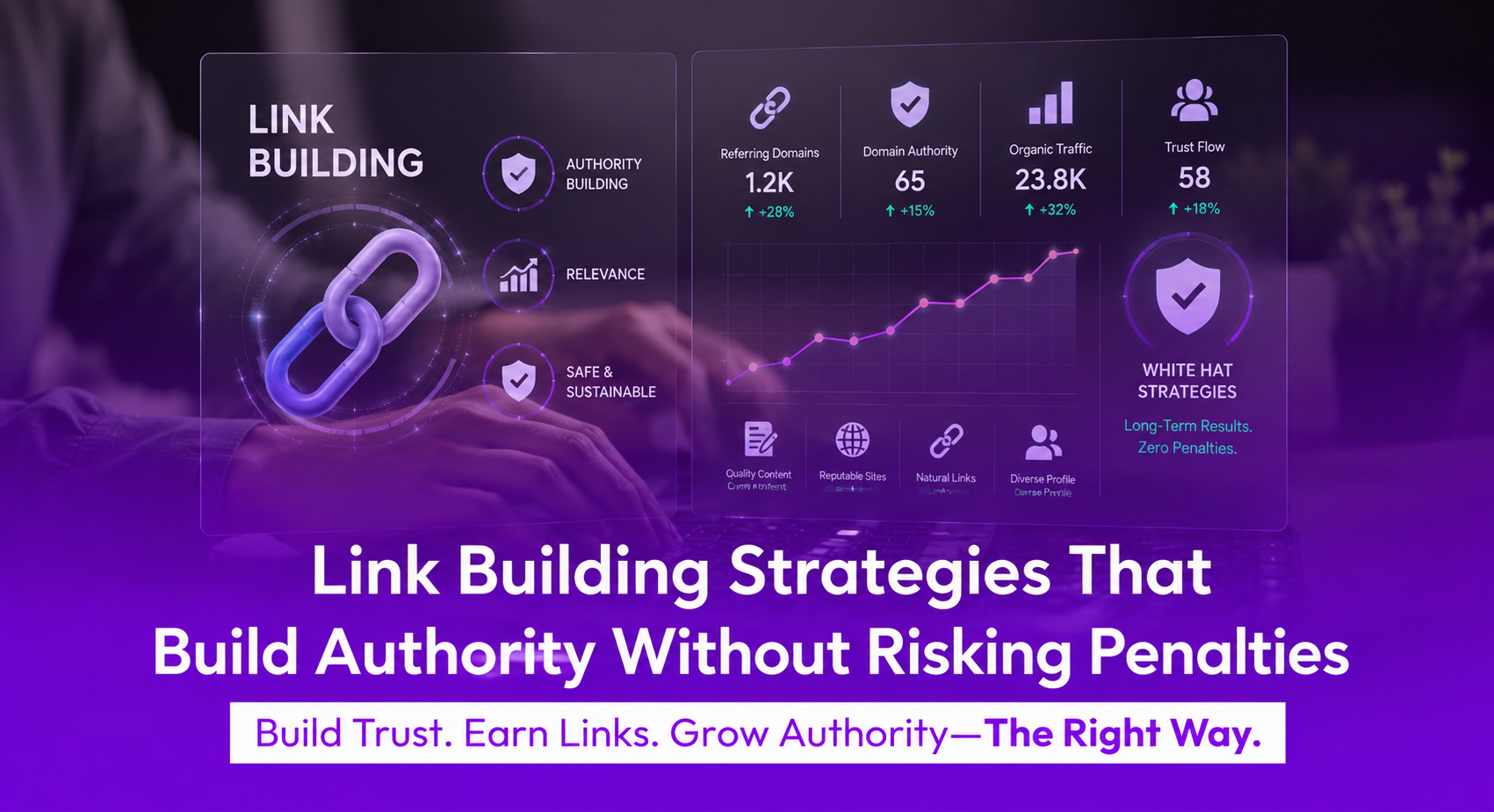
Link building strategies that hold in 2026 are built on one principle: earn links because you deserve them. This guide covers what Google penalizes and why, the difference between safe and risky tactics, and 15 white hat link building SEO methods with a clear safety rating for each. Every tactic connects to the same idea: high quality SEO backlinks are earned, not manufactured.
Why Link Building Still Matters (and Why Safe Tactics Matter More Now)
Backlinks remain one of Google’s top three ranking signals. When a credible site links to yours, it passes link equity [the trust and authority value that flows between sites]. The more relevant that site, the stronger the signal.
For Pakistani businesses, a strong backlink strategy often separates page-one rankings from page-three invisibility. Unlike paid ads, organic traffic built on quality backlinks keeps working without a monthly spend.
Google’s systems, including Spam Brain and E-E-A-T [Experience, Expertise, Authoritativeness, Trustworthiness], are far better at detecting manipulation than five years ago. With the shift toward entity-based SEO [ranking built around real-world entities, not just keywords], relevance of your backlinks now matters more than their raw count.
What Does Google Penalize in Link Building
Before we cover what works, you need to know what fails and why. Google issues two types of penalties that can damage your rankings, and most guides don’t explain either clearly.
Manual Actions
A manual action happens when a Google reviewer finds your site violates its Spam Policies and flags it directly. You’ll see it in Google Search Console under ‘Manual Actions.’ It can demote individual pages or remove your entire site from Google’s index. Fixing it requires a reconsideration request, and recovery takes weeks or months.
Algorithmic Penalties
These are automatic. Systems like Penguin [Google’s algorithm targeting manipulative link patterns] and Spam Brain scan your backlink building profile continuously. Unlike manual actions, they give you no warning. Your rankings simply drop. Common triggers include identical anchor text repeated across many links, a sudden spike in link acquisition, or a high volume of links from unrelated sites.
What Specifically Triggers a Penalty
According to Google Search Essentials, these practices count as link spam:
- Buying or selling backlinks that pass PageRank [Google’s measure of page trust and authority]
- Excessive link exchanges, trading links purely for SEO benefit
- Automated software creating backlinks at scale
- Links from Private Blog Networks [PBNs: networks of websites created only to pass links]
- Bulk submissions to hundreds of low-quality directories
- Guest posts written only to place a link, with no real audience value
Google penalizes attempts to fake authority, not the act of building links itself.
Penalty Risk by Tactic Type
Not all link building carries the same level of risk. This table maps common tactic types to their actual penalty risk and the specific reason Google flags each one. Use it as a reference before you decide where to focus your effort.
| Tactic type | Penalty risk | Why Google flags it |
| Buying links / PBNs | Critical | Directly passes PageRank for money. Google’s Spam Policy explicitly prohibits this. Manual action or algorithmic demotion follows. |
| Automated link building | Critical | Creates unnatural velocity and anchor text patterns SpamBrain detects at scale. |
| Mass guest posting (thin content) | High | When guest posts exist only for links, Google classifies them as link schemes regardless of the host site’s quality. |
| Excessive link exchanges | High | Reciprocal patterns at scale are a documented trigger in Google’s spam policies. |
| Bulk directory submissions | Medium | Unnatural acquisition pattern. Creates low-relevance link diversity that looks manufactured. |
| Grey hat guest posting (relevant, disclosed) | Low-Medium | Safe at low volume. Risk increases with scale, same-anchor repetition, and thin content. |
| White hat editorial links | Safe | Earned through editorial decision. No manipulation signal. What Google’s quality guidelines describe as ideal. |
| Digital PR and original research | Safe | Editorial at source. Journalist or editor independently decides to link. Cleanest acquisition method available. |
15 Penalty-Safe Link Building Strategies
Each tactic below shows you what it is, why Google rewards it, and specifically why it won’t trigger a penalty. Use the difficulty rating to decide where to start.
Tactic 1: Create Original Research and Data
What it is: You publish a study, survey, or data report that other websites want to cite as a source.
Why Google rewards it: Google rewards citations of original data because they represent real editorial endorsement. When a Pakistani e-commerce blog cites your survey on online shopping habits in Lahore, that backlink exists because your content informed their readers. You didn’t ask for it. It was earned.
Why it’s penalty-safe: The links come without any outreach pattern. No sudden velocity spikes, no coordinated anchor text, no manufactured relationships. Original research attracts natural, diverse backlinks from multiple independent sources.
Real-world example: A Karachi-based HR software company runs an annual salary survey for Pakistani professionals. Recruitment blogs, LinkedIn posts, and news outlets cite it year after year, generating consistent high quality SEO backlinks with zero link-building spend.
Difficulty / Time: Hard / 4–8 weeks for research design and publication, passive returns over 12+ months
Tactic 2: Guest Posting with Genuine Editorial Value
What it is: You write an article for another website that serves that site’s audience.
Why Google rewards it: When a guest post educates real readers, the link inside it is earned in context. Google’s guidance is clear: guest posts become a problem only when they’re written for the link rather than the audience.
Why it’s penalty-safe: Would this article be worth publishing without the link? If yes, you’re in safe territory. One link per post, relevant anchor text, real editorial value that combination doesn’t form a detectable manipulation pattern.
Real-world example: A Pakistani digital agency writes a guide on local SEO for a regional business publication read by Lahore SME owners. The single link back to their services page sits inside content that genuinely helps readers.
Difficulty / Time: Medium / 1–2 weeks per placement including pitch and editorial
Tactic 3: Broken Link Building
What it is: You find dead links on other websites and offer your relevant content as a working replacement.
Why Google rewards it: You’re solving a real problem for the webmaster. The replacement link is their editorial decision. Google sees a natural, contextual backlink placed by a site owner who actively chose your content.
Why it’s penalty-safe: No money changes hands. No link exchange happens. You offer a solution to a maintenance problem, and the site owner decides whether to use it. The authority flows from their independent choice.
Real-world example: An SEO agency in Islamabad finds a popular Pakistani tech blog linking to an outdated Google Ads guide that no longer exists. They offer their updated guide as a replacement and earn a relevant backlink from an established domain.
Difficulty / Time: Medium / 2–4 hours per campaign once you’ve built a content library worth linking to
Tactic 4: Digital PR Campaigns
What it is: You create a newsworthy data asset or story and pitch it to journalists and bloggers.
Why Google rewards it: Coverage from established news sites passes strong link equity because these publishers apply editorial standards before publishing. A journalist who links to your research has independently decided it’s credible and worth citing.
Why it’s penalty-safe: The reason this one is safe is straightforward: you can’t manufacture a journalist’s decision. You can pitch, but the link only exists if an editor decides your story is worth covering. That is as close to a purely editorial link as you will ever get in a link building campaign.
Real-world example: A Lahore-based fintech startup releases data on mobile payment adoption across Pakistan. Dawn, Profit by Pakistan Today, and regional tech blogs cover the story independently and link back to the original report.
Difficulty / Time: Hard / 2–6 weeks per campaign including research, press release, and targeted outreach
Tactic 5: Unlinked Brand Mention Reclamation
What it is: You find websites that already mention your brand by name without linking to you, then ask them to add a link.
Why Google rewards it: If a site already mentions your brand, adding a link improves the page for their readers. The mention proves they referenced you on their own. You’re completing a citation that already exists.
Why it’s penalty-safe: The editorial decision was made before you contacted anyone. You’re not creating a link relationship from scratch. Converting a mention to a backlink is low-risk outreach with an obvious natural explanation.
Difficulty / Time: Easy / 1–2 hours for initial setup, then ongoing monitoring
Tactic 6: Resource Page Link Building
What it is: You earn a listing on curated pages that compile useful tools, guides, or services for a specific audience.
Why Google rewards it: Resource pages exist specifically to link to helpful content. A listing on a well-maintained, topically relevant resource page is exactly the editorial placement Google’s documentation describes as natural and valuable.
Why it’s penalty-safe: The page editor decides what belongs on their list. Topically relevant resource pages that require editorial review are safe. The risk appears only when you chase low-quality directories that accept everything without review.
Real-world example: A Pakistani accountancy firm earns a listing on a ‘Small Business Resources in Pakistan’ page maintained by a local chamber of commerce website. The link is contextually clear and editorially placed.
Difficulty / Time: Easy to Medium / 1–3 hours per campaign
Tactic 7: Link Reclamation from Lost Backlinks
What it is: You recover backlinks that once pointed to your site but broke when pages were deleted or URLs changed.
Why Google rewards it: A link that already pointed to your site was earned. Recovering it restores link equity that existed in your profile before. It doesn’t create a new acquisition pattern.
Why it’s penalty-safe: You’re repairing your existing profile, not building new patterns. No anchor text ratios shift. No velocity spikes happen. Google doesn’t flag recovery of legitimate historical backlinks.
Difficulty / Time: Easy / 2–4 hours for a backlink audit and targeted outreach
Tactic 8: Expert Commentary and Journalist Sourcing
What it is: You contribute expert quotes or insights to journalists writing articles in your field, similar to how HARO works.
Why Google rewards it: Backlinks from expert commentary come from established publications that verify their sources before publishing. The journalist decides whether your insight is worth including not you.
Why it’s penalty-safe: Each placement comes from a different journalist at a different publication. There’s no pattern for Google to read because there’s no pattern to form. You contribute, you wait, and the editorial decision belongs entirely to someone else. That’s the cleanest possible link acquisition process.
Real-world example: A cybersecurity consultant in Pakistan responds to a journalist’s request for comment on data privacy regulations. Their expert insight appears in a regional tech publication with a contextual backlink to their firm’s site.
Difficulty / Time: Medium / 30 minutes per response, with consistent weekly effort required to see results
Tactic 9: Linkable Asset Creation (Tools, Templates, Calculators)
What it is: You build a free, useful tool or downloadable resource that people naturally want to share and reference.
Why Google rewards it: Linkable assets attract backlinks passively over time. A useful calculator gets embedded in blog posts, shared on forums, and bookmarked by business owners from diverse, independent sources without any outreach.
Why it’s penalty-safe: No manipulation pattern forms because links arrive from varied sources over an extended period. No consistent anchor text. No coordinated velocity. No relationship required with linking sites.
Real-world example: A Pakistani HR platform launches a free Employee Leave Calculator tailored to Pakistani labour law. Over 12 months, HR blogs and business forums link to it repeatedly without any outreach from the platform.
Difficulty / Time: Hard to create / 2–6 weeks of development, then passive returns for months or years
Tactic 10: Podcast and Webinar Appearances
What it is: You appear on industry podcasts or webinars as a guest expert and earn a contextual link in the show notes.
Why Google rewards it: These links come from editorial decisions by hosts who chose to invite you and decided to feature your link as a resource for their listeners.
Why it’s penalty-safe: Podcast backlinks are naturally diverse: different domains, different anchor texts, different audiences. They arrive at a pace that matches your appearance schedule. No algorithm reads this as manipulative.
Real-world example: A Pakistani marketing consultant appears on a Karachi-based startup podcast series. Each episode’s published show notes link back to their agency site, building a steady stream of relevant editorial backlinks.
Difficulty / Time: Easy / 1–2 hours per appearance including prep and recording
Tactic 11: Skyscraper Content (Actual Quality Improvement, Not Just Length)
What it is: You find high-ranking content on a topic, create a demonstrably better version, and reach out to sites linking to the original.
Why Google rewards it: When your content is more useful, editors who update their links make an improvement for their own readers. Topical authority builds when your page becomes the clearest resource on a subject.
Why it’s penalty-safe: The safety depends entirely on whether your content is actually better. If it is, outreach converts because site owners want to cite the best available resource. If it isn’t, you’re sending cold emails for a content upgrade that doesn’t exist and mass outreach with weak content is itself a pattern Google reads through unnatural anchor text uniformity and link velocity.
Real-world example: A Pakistani software agency creates a more detailed, current guide on project management tools compared to a widely cited 2021 article. They contact editors linking to the old article and convert several to their updated guide.
Difficulty / Time: Hard / 4–8 weeks of content production plus 1–2 weeks of targeted outreach
Tactic 12: Niche Directory Listings (Quality Over Quantity)
What it is: You list your business in respected, editorially reviewed industry or regional directories.
Why Google rewards it: A listing in a credible, curated directory counts as an editorial placement. Well-known directories in your industry are legitimate, low-risk sources of link equity.
Why it’s penalty-safe: One or two well-chosen, relevant directories are safe. Bulk-submitting to 200 generic directories creates an unnatural pattern. Pick directories that require editorial review and that your actual target audience in Pakistan uses.
Difficulty / Time: Easy / 1–2 hours total for research and submission
Tactic 13: Co-Authored Content with Industry Partners
What it is: You collaborate with a non-competing business to produce content that both parties promote.
Why Google rewards it: Co-authored content earns backlinks from both parties’ audiences. When each partner promotes it to their own audience, the resulting links come from diverse, independent sources. Google reads this as organic promotion, not a link exchange.
Why it’s penalty-safe: This is not a link swap. The backlinks that follow come from third parties choosing to share the content, not from the co-authors linking to each other. That distinction keeps it clean.
Real-world example: A Pakistani web design agency co-authors a guide on launching an e-commerce store with a local payment gateway provider. Both promote it to their separate audiences. Links arrive from the startup and e-commerce community across Pakistan.
Difficulty / Time: Medium / 2–3 weeks for content creation and partner coordination
Tactic 14: Forum and Community Contributions (Value First, Never Spam)
What it is: You contribute expertise to relevant online communities and include your link only where it directly helps the person asking.
Why Google rewards it: Links from real forum discussions on platforms like Reddit, Quora, or Pakistani tech forums add topical diversity to your backlink profile. Note that most forum links are nofollow [meaning they don’t pass direct PageRank], but they drive real traffic, build brand signals, and contribute to a natural-looking link profile.
Why it’s penalty-safe: The penalty risk in forums comes from spam: mass account creation, low-quality replies, links in irrelevant threads. Consistent contributions from a real account in threads where your link actually helps someone are safe.
Real-world example: A Pakistani web hosting company regularly answers technical questions on a well-known Pakistani tech forum. Their links to relevant support documentation are useful to the community and build a diverse, natural backlink profile over time.
Difficulty / Time: Easy / Ongoing, 30–60 minutes per week
Tactic 15: Regional Press Coverage and Pakistani Media Mentions
What it is: You pitch genuine stories to Pakistani news outlets, regional blogs, and local industry publications.
Why Google rewards it: Regional press links carry strong relevance signals for Pakistani businesses. A backlink from Dawn, The News, or Profit by Pakistan Today delivers authority, topical relevance, and geographic signals that directly support rankings in Pakistani SERPs.
Why it’s penalty-safe: Journalists decide what to cover. You can pitch ideas, but the editorial decision and the link belong to the publication. These are among the cleanest backlinks in any SEO link building strategy.
Real-world example: A Lahore-based agri-tech startup shares data on improved crop yields using their platform. Profit by Pakistan Today covers the story and links to their site — a high-authority, editorially earned backlink from one of Pakistan’s most trusted digital publications.
Difficulty / Time: Medium to Hard / Requires genuine newsworthy content and a targeted media pitch
How Long Does Link Building Take
This is one of the most common questions Pakistani business owners ask, and most guides skip it. The honest answer is: longer than most people expect, and faster than most people fear.
- 0–3 months: Foundation stage. Brand mention reclamation, resource page listings, and directory submissions start producing links within weeks. No ranking shifts yet, but your referring domain count should climb.
- 3–6 months: Consistency pays. Regular guest posting, podcast appearances, and broken link building produce steady referring domain growth. Google starts registering your profile as a real pattern. Lower-competition keywords usually show traffic movement here.
- 6–12 months: The compounding stage. Digital PR and original research links from earlier months mature. If your content is strong and on-site SEO is clean, page-one rankings for primary keywords become achievable.
Link building is not a campaign. It’s an ongoing part of running a site that wants to rank. The businesses that quit at month two are the same ones restarting at month eight.
How Do You Measure Link Building Results Safely
Tracking the right signals in SEO services lets you catch problems before Google does.
- Referring domains over raw link count. One hundred links from eighty different sites outweigh one hundred links from ten. Track referring domain diversity monthly using Ahrefs, Semrush, or Google Search Console.
- Anchor text spread. Branded and generic anchors should make up the majority of your profile. If more than 20–30 percent of your links use the exact same keyword phrase, Google flags it.
- Link velocity. Growth should be steady, not sudden. A site averaging five backlinks a month that jumps to two hundred in one week looks suspicious even if every link is clean.
- Manual Actions report. Check Google Search Console every month. Set alerts for sudden drops in referring domains, catching this early in SEO services keeps your profile clean.
Red Flags: Is Your Backlink Profile Getting Risky
Other sites can link to yours without your knowledge. Not all of those links will be clean. Watch for these warning signs.
• Sudden spike in low-quality links. A sharp rise in links from unrelated foreign sites may signal a negative SEO attack. Use Ahrefs or Semrush alerts and investigate immediately; don’t wait for a traffic drop to confirm it.
• High percentage of exact-match anchor text. More than 20–30 percent of links using your target keyword as anchor text is a warning sign. Natural backlink profiles don’t look like that.
• Links from clearly unrelated sites. A Karachi accounting firm receiving links from gambling or pharmaceutical sites didn’t earn those. Flag them in your disavow file straight away.
• Traffic drops around Google update dates. If your organic traffic falls without a technical site error and the timing aligns with a known Google update, check your backlink profile first.
• Links from known PBN domains. Ahrefs and Semrush flag domains with PBN-like characteristics. Review your profile quarterly and disavow confirmed PBN links.
Conclusion
The Pakistani businesses ranking well on Google in three years are building clean, relevant, editorially earned backlinks right now not chasing shortcuts that the next algorithm update will remove. At fulfillit, a provider of SEO services, the focus is on sustainable, white-hat link acquisition strategies that prioritize long-term authority over short-term gains.
Every tactic in this guide works for the same reason: it produces links that a human editor chose to place because your content deserved it. A strong backlink building strategy requires consistency and an honest understanding of what quality means.
Start with the easier tactics: brand mention reclamation, resource page listings, and podcast appearances. Build a rhythm. Then add the higher-effort tactics like digital PR and original research as your domain authority grows. Every link you earn through this guide strengthens your SEO link building profile without adding penalty risk.
Frequently Asked Questions
Is link building still worth it for Pakistani websites in 2026?
Yes. Backlinks remain one of Google’s top three ranking signals. For Pakistani businesses, a clean and relevant backlink building profile is often what separates a page-one result from a page-three one. The return on investment from high quality SEO backlinks compounds over time in a way that paid advertising doesn’t.
What’s the difference between a manual action and an algorithmic penalty?
A manual action comes from a Google employee who reviews your site and finds it violates Spam Policies. It appears in Google Search Console and requires a formal reconsideration request to lift. An algorithmic penalty is automatic, applied by systems like Penguin or Spam Brain, and shows up as a traffic drop with no notification. Both damage rankings, but manual actions at least tell you why.
How many backlinks do I need to rank on page one?
There’s no fixed number. It depends on your niche, market, and competitors. A local accountancy firm in Faisalabad needs far fewer backlinks than a national e-commerce site competing with Daraz. Quality and topical relevance outperform volume every time. Five editorial links from credible Pakistani industry sites will outrank fifty links from generic directories.
Can I get penalized for backlinks I didn’t build myself?
Google’s systems are designed to ignore unnatural-looking links rather than automatically penalizing every site that receives them. That said, coordinated negative SEO attacks can sometimes cause harm. Monitor your SEO backlink services profile monthly and use the Disavow Tool if you identify a serious pattern of manipulative links pointing to your domain.
Is guest posting safe in 2026?
Yes, if you do it right. Guest posts with genuine audience value, written for a real readership on a topically relevant site, with a single contextual link, are safe. What Google targets is scale: thin content published across dozens of unrelated sites with the only purpose being link placement. Intent and editorial quality are what separate safe link building SEO from link spam.